


When the dApp asks you to sign: a case-led read on using Rabby Wallet for DeFi power users
Imagine you’re on a Friday evening in New York, scanning an Arbitrum AMM for a fresh liquidity opportunity. The pool promises attractive yields but requires a two-step approval and a contract interaction that looks unusual. You can proceed fast—click sign, click confirm—or stop and ask what exactly that transaction will do to your balances and approvals. For many active DeFi users in the US market, that choice separates routine trade from a potential cleanout. This article uses that concrete scenario to explain how Rabby Wallet’s design choices—transaction simulation, risk scanning, approval revocation, and multi-chain ergonomics—change the decision-making calculus for sophisticated users, and where those protections still leave gaps.
Rabby is not an incremental UI tweak: it is a security-first wallet built by DeBank that embeds defensive mechanisms into the signing flow. These mechanisms change the mental model from “trust the dApp and sign” to “inspect a simulated outcome, then sign.” That shift matters because the surface symptoms of many DeFi incidents (malicious approvals, mishandled allowances, wrong-chain swaps) are exploitable precisely because users rarely see a clear, pre-sign summary of balance changes and gas implications.
How Rabby works: mechanisms that matter to a power user
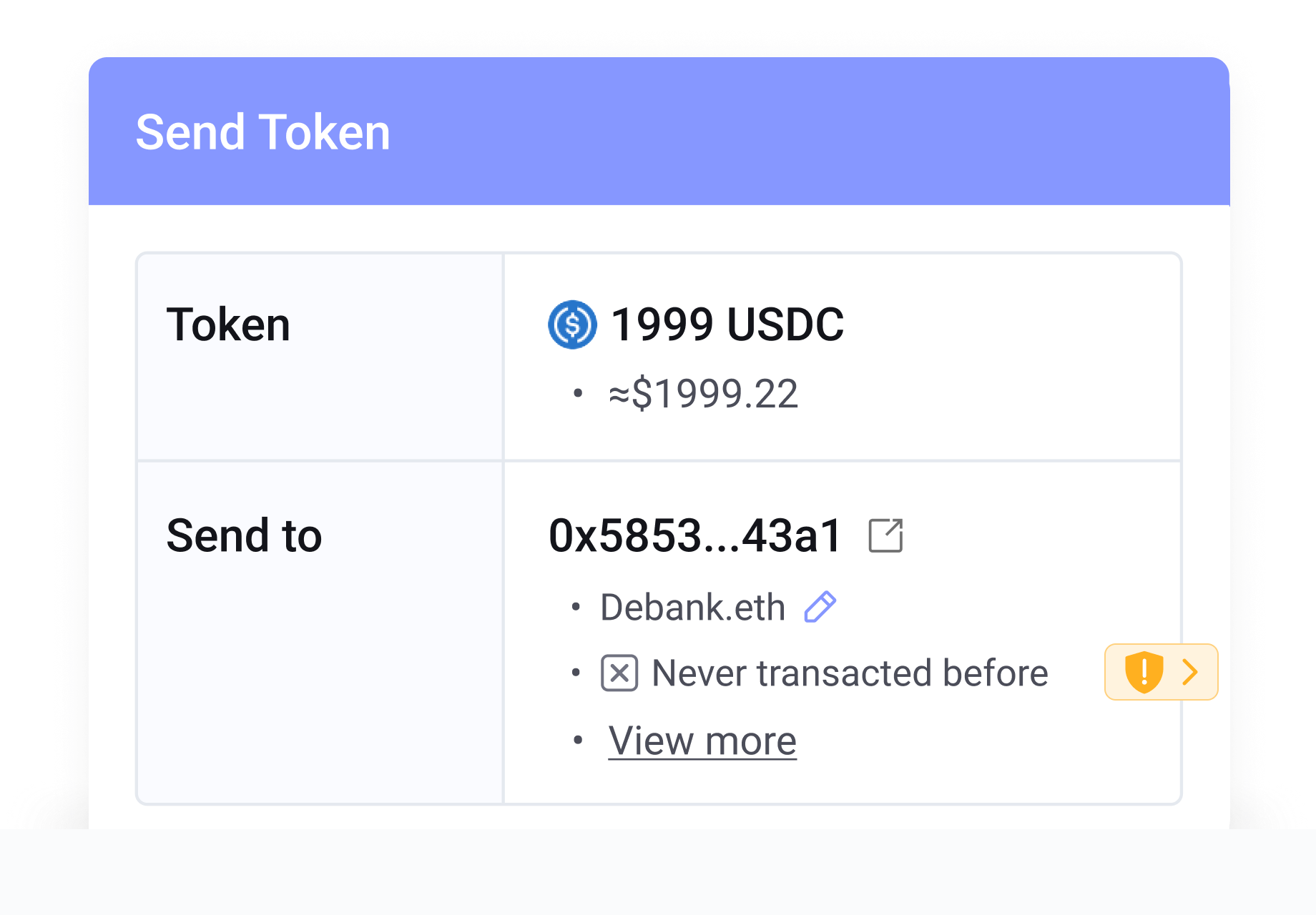
At the core are three mechanisms: transaction simulation, pre-transaction risk scanning, and approval management. Transaction simulation executes a dry-run of the intended operation against a node (or a simulation engine) and returns estimated token deltas and fee costs. For the user, the result is concrete: “You will lose X tokens, receive Y tokens, and pay Z gas.” This removes a lot of the opaque mental accounting that makes blind signing dangerous.
Pre-transaction risk scanning layers contextual intelligence on top of that simulation. It flags interactions with contracts previously linked to hacks, suspicious approval requests, or non-existent recipient addresses. That doesn’t make Rabby omniscient—new exploits won’t be in any blacklist until discovered—but the engine reduces many classes of accidental exposure that trip up even experienced traders.
Finally, the built-in approval revocation utility turns approval management from a chore into a tool. Instead of accepting indefinite ERC-20 allowances and hoping for the best, users can audit active approvals and revoke them with a couple of clicks. For portfolios with many trading pairs, that reduces long-term attack surface significantly.
Where Rabby fits among alternatives: trade-offs and practical comparisons
Compare Rabby with three common alternatives: MetaMask, Trust Wallet, and Coinbase Wallet. MetaMask is the ubiquitous default and broadly compatible; its strengths are ecosystem fit and developer familiarity. But it lacks a built-in, user-facing transaction simulation and the same degree of pre-sign risk scanning Rabby provides. Trust Wallet and Coinbase Wallet prioritize mobile simplicity and fiat on-ramps, respectively, and are attractive for casual or fiat-oriented flows. Rabby explicitly trades the on-ramp convenience and some mobile-first simplicity for deeper in-flow security and multi-chain operational features.
Two practical trade-offs emerge. First, Rabby lacks a built-in fiat on-ramp and in-wallet staking: for US users who want the entire flow—from USD to stake—inside one app, Rabby will require pairing with exchanges or services. Second, the security model is stronger for sign-time decisions but still depends on upstream factors: the node or provider used for simulation, the completeness of risk intelligence, and the timeliness of threat data. In short, Rabby reduces many human-driven errors but cannot eliminate systemic risks such as zero-day contract exploits or supply-chain compromises.
Operational features DeFi power users will care about
Several practical capabilities make Rabby relevant for advanced traders and ops teams. Multi-chain support for 90+ EVM chains lowers the friction of moving across L2s and alternative L1s; automatic network switching detects the dApp’s target chain and flips networks for you, which prevents common failures caused by sending a signed transaction on the wrong network. Cross-chain gas top-up is a small but high-value feature: when you need to operate on a less-funded chain, you can top up gas tokens without leaving the wallet flow.
For institutional or shared-risk contexts, Rabby’s integrations with multi-sig and custody providers (Gnosis Safe, Fireblocks, Amber) mean it can slot into an operational security posture that already relies on higher-assurance signing and audit trails. The open-source MIT license is another practical advantage: firms can audit the codebase or build custom tooling atop it.
Limitations and real risks—what Rabby does not solve
Honesty about limits is essential. Rabby can reduce accidental exposure and make signing decisions more informed, but it does not make you invulnerable. The 2022 Rabby Swap exploit—about $190,000 lost to a compromised contract—shows that even projects with strong defensive orientations can suffer. Rabby’s response then (freeze, compensate, tighten audits) is evidence of responsive governance, but it does not negate the reality of technical risk.
Operationally, Rabby’s protections depend on accurate simulation and up-to-date risk intelligence. Simulations can be blind to on-chain state that changes between simulation and finality (front-running, reorgs, mempool manipulation), and many attacks rely on contract-level logic that a heuristic scanner can miss. Hardware wallet integration (Ledger, Trezor, Keystone and others) raises the bar, but it also adds complexity: key storage remains only as secure as the hardware and its supply chain. Finally, the absence of fiat rails means a US user must still navigate regulated on- and off-ramps outside the Rabby context, which introduces KYC/AML trade-offs and liquidity fragmentation.
Decision framework: when to use Rabby and when not to
For a power user, decide along three axes: frequency of complex interactions, exposure tolerance, and ecosystem connectivity. If you interact frequently with unfamiliar contracts, use multiple chains, and prioritize minimizing blind approvals, Rabby is a high-leverage tool. If your needs center on buying crypto with USD, custodial simplicity, or native staking inside the wallet, a different product may be more efficient.
Heuristic to reuse: if a trade involves nonstandard approvals (infinite allowances, contracts without clear audit provenance, or multiple token hops), pause and require a simulated balance delta. Rabby makes that pause pragmatic by showing the delta in the UI; in other wallets you must reconstruct it mentally or consult external tools. Use hardware-backed signing for high-value operations, revoke approvals after one-off interactions, and keep an institutional policy for allowances and whitelisting smart contracts you trust.
What to watch next: conditional scenarios that would change the calculus
Three signals would materially affect Rabby’s attractivity for US power users. First, the addition of integrated fiat on-ramps with compliant partners would move Rabby from a specialist security tool toward a broader consumer entry point—this is conditional on successful regulatory integrations. Second, improvements in real-time simulation fidelity (for example, mempool-aware simulation or private-node tie-ins) would reduce the window where simulation diverges from execution. Third, repeated security incidents—either in Rabby’s codebase or in widely used integrations—would reduce trust and favor simpler custodial options even for advanced users.
Monitor the open-source repo and third-party audits as near-term signals: frequent audits and responsive patches are positive; slow merges and public silence during incidents are not. For institutions, the degree of enterprise integrations and formal attestations will be decisive.
FAQ
Is Rabby safer than MetaMask for active DeFi trading?
Rabby provides stronger in-flow protections—transaction simulation, pre-sign risk scanning, and an approval revocation tool—that reduce the chance of accidental exposure during complex trades. MetaMask remains broadly compatible and familiar, but lacks those built-in defensive layers. “Safer” depends on the threat model: for preventing blind-signing mistakes, Rabby is superior; for integration ubiquity and fiat access, MetaMask or custodial wallets may be more convenient.
Can Rabby prevent smart contract exploits?
No wallet can fully prevent smart contract vulnerabilities or zero-day exploits. Rabby’s scanners can flag known-bad contracts and suspicious approval patterns, and simulation can reveal unintended balance changes, but novel logic bugs or freshly deployed malicious contracts can still cause losses. Treat Rabby as risk-reduction, not risk elimination.
Does Rabby support hardware wallets and multi-sig setups?
Yes. Rabby integrates with popular hardware devices (Ledger, Trezor, Keystone, CoolWallet, and others) and works with institutional multi-sig solutions like Gnosis Safe, which lets teams combine Rabby’s UX with stronger operational controls.
How should a US-based DeFi trader incorporate Rabby into their workflow?
Use Rabby for noncustodial signing and multi-chain activity, especially when interacting with unfamiliar contracts. Pair it with a regulated on-ramp for fiat needs and use hardware devices for high-value transactions. Maintain a process to revoke approvals periodically and treat the simulation screen as required reading before any significant sign action.
For readers who want to try the wallet and inspect its security-focused UX, see this entry page for the project: rabby wallet. The core lesson is practical and modest: design choices that make the signing moment explicit will improve outcomes for skilled traders more than aesthetic changes ever will. Whether Rabby becomes your daily driver depends on how much you trade across chains, how much you value pre-sign transparency, and how you balance convenience against a clearer, safer signing posture.